
3D Dental CBCT Scan
A dental CBCT (Cone Beam Computed Tomography) scan produces a three-dimensional image of the jaw, teeth, nerve canals and sinuses in under a minute — used to plan dental implants, assess impacted teeth, retreat complex root canals and evaluate the TMJ, with a radiologist-read report delivered within 24 hours.
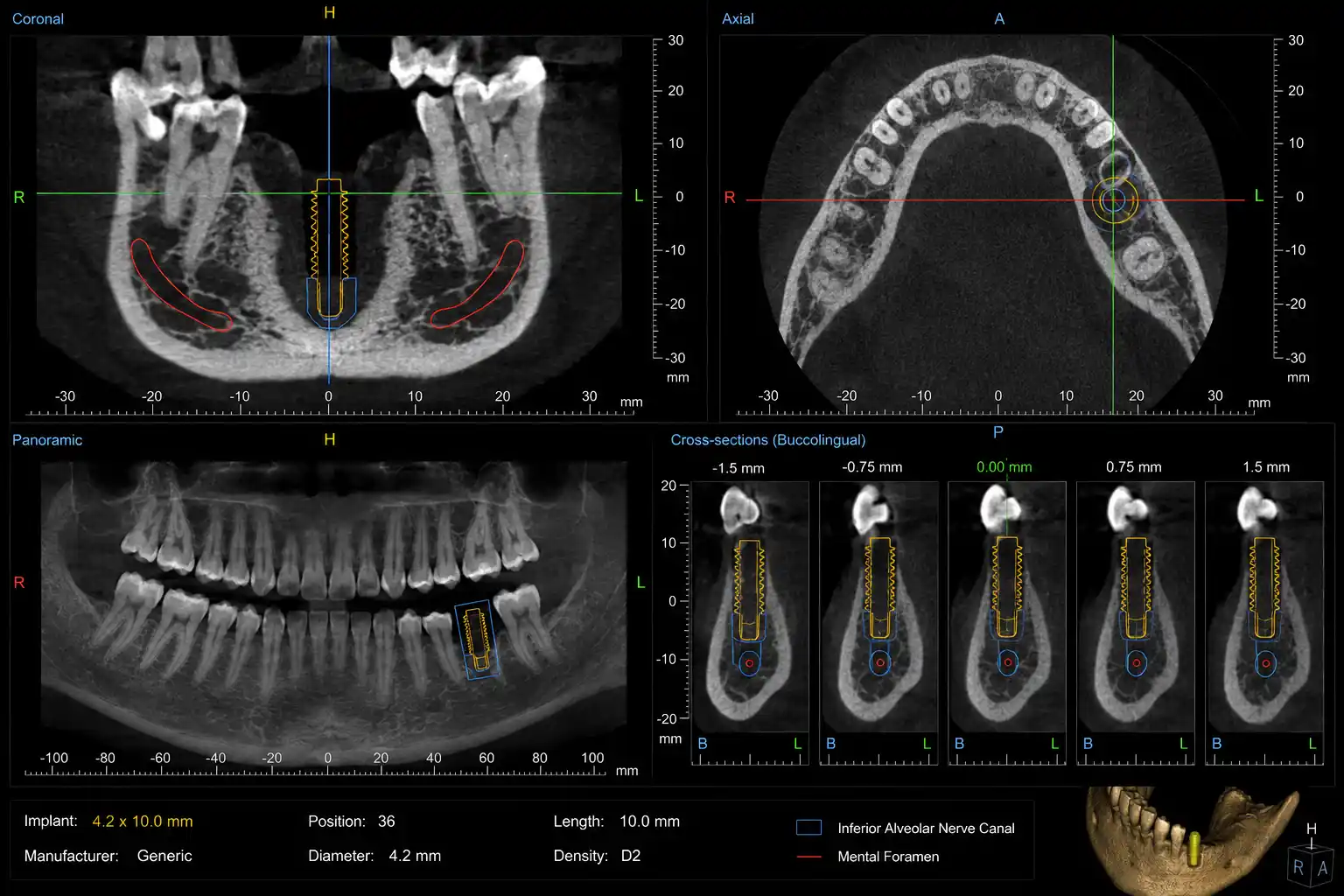
What a CBCT scan shows
Unlike a flat 2D X-ray, CBCT reconstructs bone density, nerve position and root anatomy in three dimensions. This lets your dentist see exactly how much bone is available for an implant, where the inferior alveolar nerve runs, and whether a root canal has a hidden extra canal a 2D image would miss.
Common uses: implant site planning, impacted wisdom tooth assessment, complex root canal retreatment, TMJ and airway evaluation, and pre-surgical planning for oral surgery.
Is a CBCT scan right for your patient?
Implant patients
Precise bone volume and nerve mapping before implant placement, and the basis for a surgical guide if one is needed.
Complex root canal cases
Reveals extra canals, resorption and periapical lesions that OPG or bitewing X-rays can miss.
Impacted or surgical cases
Maps the exact position of impacted teeth relative to nerves and adjacent roots before extraction or surgery.
Scan time
Under 1 minute of active scanning; the full appointment, including positioning, takes about 15 minutes.
Radiation dose
Field of view is sized to the clinical question, and our units are calibrated to ALARA (as low as reasonably achievable) dose protocols.
Report delivery
A radiologist-read report with annotated 3D reconstructions is delivered to the referring dentist within 24 hours.
Preparation
No special preparation needed. Remove removable metal appliances such as retainers or dentures before the scan.